

Blog
2026-3-4
What is the difference between an AC contactor and a relay?
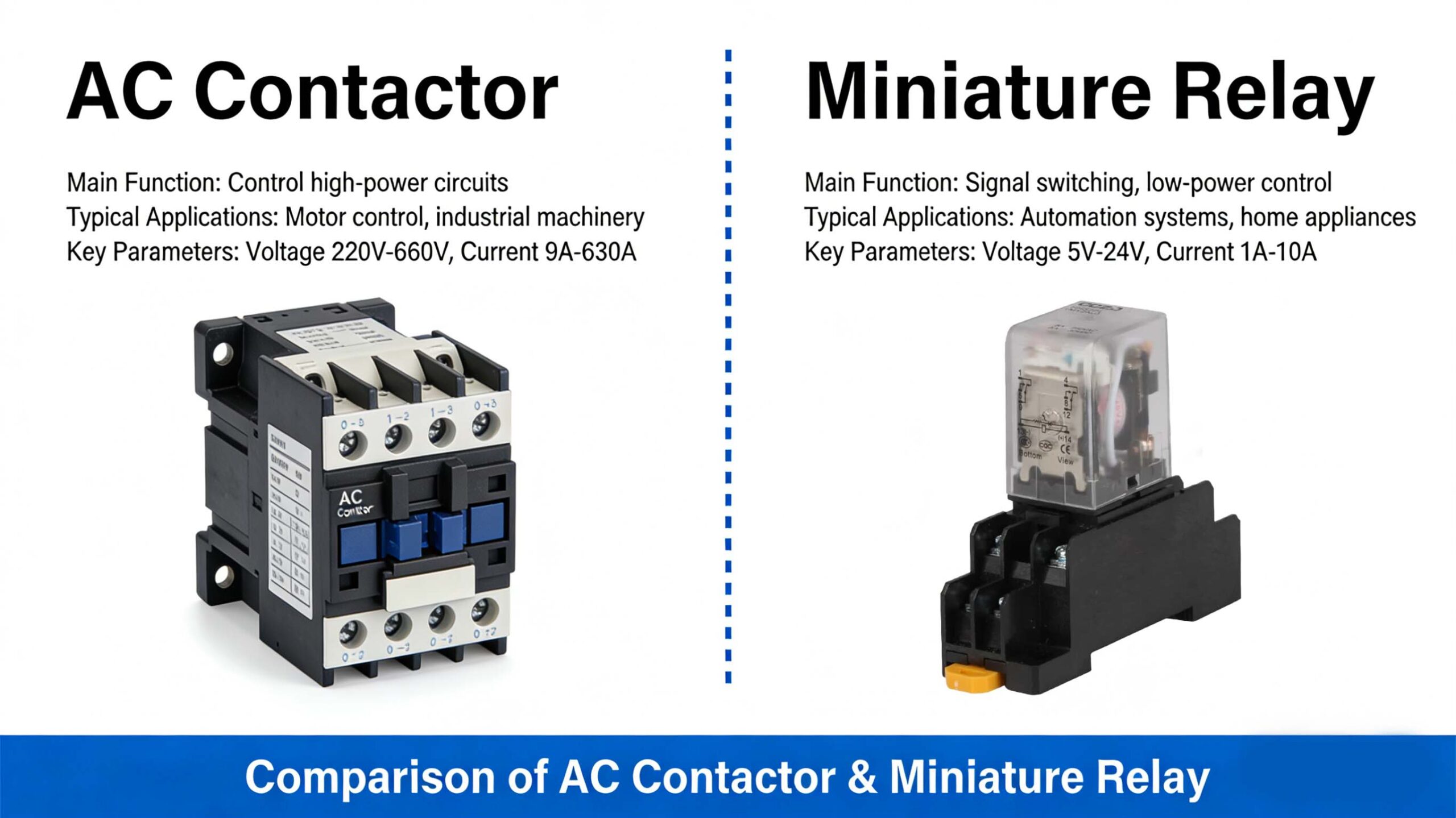
Relays manage “signals”, while contactors manage “power”. They are often used together and cannot be substituted casually.
1. Core Function & Position (The Most Essential Difference)
(1) Relay
It does not directly drive high-power equipment; it only transmits, converts and amplifies electrical signals to realize logic control, contact expansion and electrical isolation between strong and weak current.
In short: It only sends commands, not heavy workloads.
(2) AC Contactor
It is specially designed to directly connect and disconnect high-power AC main circuits, bear large-current switching tasks, and control the start/stop of heavy equipment such as motors, fans and water pumps.
In short: It does not send commands, only performs heavy work.
2. Rated Current & Load Capacity (The Most Intuitive Difference)
(1) Relay
- Extremely small rated current: Normally 5A, 10A, maximum no more than 15A;
- Only drives low-power light loads: indicator lights, solenoid valves, buzzers, contactor coils, sensors, etc.;
- Must never drive high-power equipment (motors, heaters), otherwise the contacts will burn out instantly.
(2) AC Contactor
- Extremely large rated current: Commonly 9A~630A in industry, up to thousands of amps for ultra-high-power equipment;
- Specially drives high-power heavy loads: three-phase asynchronous motors, central air conditioners, water pumps, fans, air compressors, electric furnaces, etc.;
- The main contacts are designed for large current and can carry the working current of equipment for a long time.
3. Structural Design (Core Hardware Differences)
(1) Contact System (The Most Obvious Appearance Difference)
Relay
- No distinction between main and auxiliary contacts; all are small-capacity auxiliary contacts (NO / NC);
- Large number of contact groups (4, 8, 14 groups, etc.), compact size, small contact area;
- Only used for low-current signal circuits, not for main circuit current.
AC Contactor
- Strictly divided into two types of contacts:
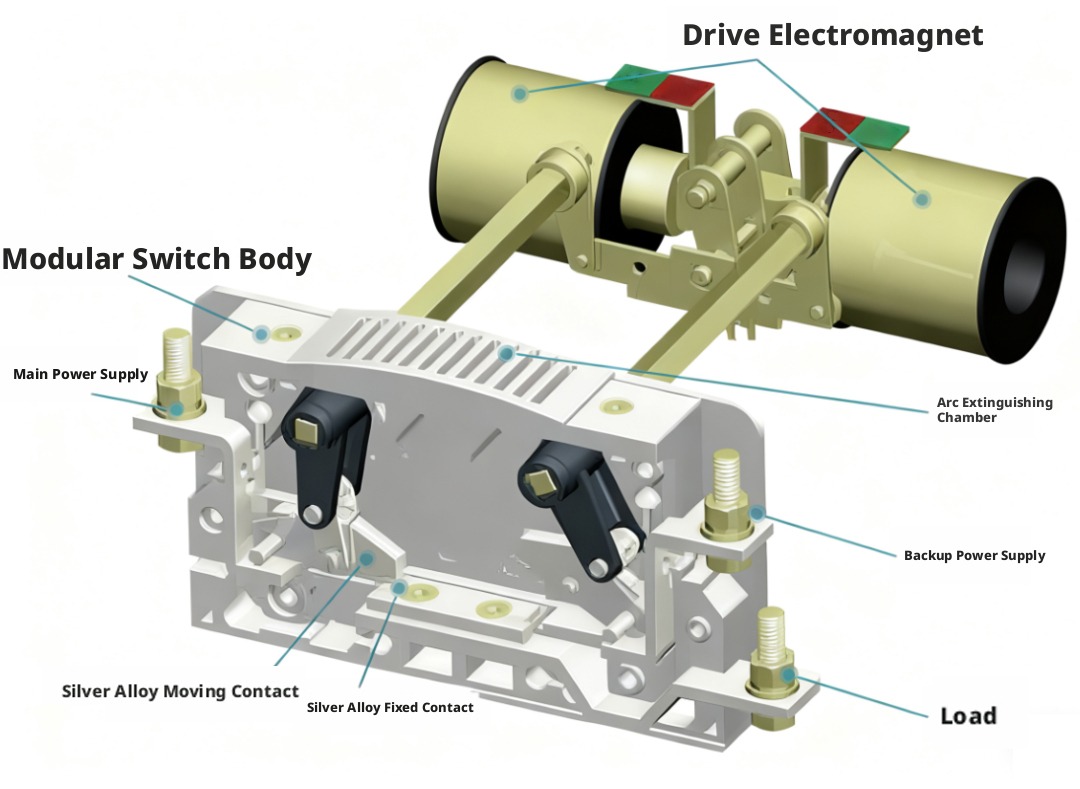
✅ Main contacts: 3 groups (for three-phase power), large and thick contacts, dedicated for high-current main circuits;
✅ Auxiliary contacts: 1~2 groups (NO / NC), low-current, for self-locking and interlocking in control circuits;
- The main contacts are the core, and the auxiliary contacts only support functions.
(2) Arc Extinguishing Device
Relay
No arc extinguishing structure:
The current is too small to generate electric arc during switching, so no arc extinguishing is needed.
AC Contactor
High-temperature electric arcs are generated when cutting off large current, which easily erodes contacts and causes short circuits. The arc extinguishing device quickly extinguishes the arc to protect contacts and circuit safety.
(3) Size & Material
- Relay: Small, lightweight, mainly plastic shell;
- AC Contactor: Large, heavy, iron core and contacts made of copper/silver alloy, high temperature and large current resistant.
4. Practical Applications & Circuit Roles
(1) 4 Core Uses of Relays
- Signal amplification: Control larger circuits with tiny current (e.g. PLC 24V output);
- Contact expansion: Add switching points when original switch contacts are insufficient;
- Logic control: Realize self-locking, interlocking, linkage and time-delay control of circuits;
- Electrical isolation: Separate strong and weak current to protect control equipment.
(2) 3 Core Uses of AC Contactors
- Direct start/stop: Control the start, operation and stop of three-phase AC high-power equipment;
- Remote control: Control on-site equipment remotely via control room buttons/PLC signals;
- Frequent operation: Support high-frequency start/stop (hundreds of times a day), which ordinary manual switches cannot achieve.
5. Other Key Differences
| Comparison Item | Relay | AC Contactor |
|---|---|---|
| Coil Voltage | AC/DC universal (DC24V/AC220V most common) | Dedicated for AC coils (AC220V/AC380V mainly) |
| Service Life | Ultra-long mechanical life (hundreds of millions of times), suitable for high-frequency signal switching | Electrical life for large current, slightly shorter mechanical life |
| Protection Function | No protection capability, only switching | Can match thermal relays for motor overload protection |
| Circuit Position | Control circuit (low-voltage side) | Main circuit (high-voltage side) + Control circuit |
6. Final Summary (Easy to Remember)
✅ AC Contactor: High-voltage power switch, manages high power, large current and equipment start/stop — the “worker”.
Share This Article
What is the difference between an AC contactor and a relay?
Relays manage “signals”, while contactors manage “power”. They are often used together and cannot be substituted casually.
1. Core Function & Position (The Most Essential Difference)
(1) Relay
It does not directly drive high-power equipment; it only transmits, converts and amplifies electrical signals to realize logic control, contact expansion and electrical isolation between strong and weak current.
In short: It only sends commands, not heavy workloads.
(2) AC Contactor
It is specially designed to directly connect and disconnect high-power AC main circuits, bear large-current switching tasks, and control the start/stop of heavy equipment such as motors, fans and water pumps.
In short: It does not send commands, only performs heavy work.
2. Rated Current & Load Capacity (The Most Intuitive Difference)
(1) Relay
- Extremely small rated current: Normally 5A, 10A, maximum no more than 15A;
- Only drives low-power light loads: indicator lights, solenoid valves, buzzers, contactor coils, sensors, etc.;
- Must never drive high-power equipment (motors, heaters), otherwise the contacts will burn out instantly.
(2) AC Contactor
- Extremely large rated current: Commonly 9A~630A in industry, up to thousands of amps for ultra-high-power equipment;
- Specially drives high-power heavy loads: three-phase asynchronous motors, central air conditioners, water pumps, fans, air compressors, electric furnaces, etc.;
- The main contacts are designed for large current and can carry the working current of equipment for a long time.
3. Structural Design (Core Hardware Differences)
(1) Contact System (The Most Obvious Appearance Difference)
Relay
- No distinction between main and auxiliary contacts; all are small-capacity auxiliary contacts (NO / NC);
- Large number of contact groups (4, 8, 14 groups, etc.), compact size, small contact area;
- Only used for low-current signal circuits, not for main circuit current.
AC Contactor
- Strictly divided into two types of contacts:
✅ Main contacts: 3 groups (for three-phase power), large and thick contacts, dedicated for high-current main circuits;
✅ Auxiliary contacts: 1~2 groups (NO / NC), low-current, for self-locking and interlocking in control circuits;
- The main contacts are the core, and the auxiliary contacts only support functions.
(2) Arc Extinguishing Device
Relay
No arc extinguishing structure:
The current is too small to generate electric arc during switching, so no arc extinguishing is needed.
AC Contactor
High-temperature electric arcs are generated when cutting off large current, which easily erodes contacts and causes short circuits. The arc extinguishing device quickly extinguishes the arc to protect contacts and circuit safety.
(3) Size & Material
- Relay: Small, lightweight, mainly plastic shell;
- AC Contactor: Large, heavy, iron core and contacts made of copper/silver alloy, high temperature and large current resistant.
4. Practical Applications & Circuit Roles
(1) 4 Core Uses of Relays
- Signal amplification: Control larger circuits with tiny current (e.g. PLC 24V output);
- Contact expansion: Add switching points when original switch contacts are insufficient;
- Logic control: Realize self-locking, interlocking, linkage and time-delay control of circuits;
- Electrical isolation: Separate strong and weak current to protect control equipment.
(2) 3 Core Uses of AC Contactors
- Direct start/stop: Control the start, operation and stop of three-phase AC high-power equipment;
- Remote control: Control on-site equipment remotely via control room buttons/PLC signals;
- Frequent operation: Support high-frequency start/stop (hundreds of times a day), which ordinary manual switches cannot achieve.
5. Other Key Differences
| Comparison Item | Relay | AC Contactor |
|---|---|---|
| Coil Voltage | AC/DC universal (DC24V/AC220V most common) | Dedicated for AC coils (AC220V/AC380V mainly) |
| Service Life | Ultra-long mechanical life (hundreds of millions of times), suitable for high-frequency signal switching | Electrical life for large current, slightly shorter mechanical life |
| Protection Function | No protection capability, only switching | Can match thermal relays for motor overload protection |
| Circuit Position | Control circuit (low-voltage side) | Main circuit (high-voltage side) + Control circuit |
6. Final Summary (Easy to Remember)
✅ AC Contactor: High-voltage power switch, manages high power, large current and equipment start/stop — the “worker”.