

Blog
2026-4-3
What is an electronic molded-case circuit breaker?
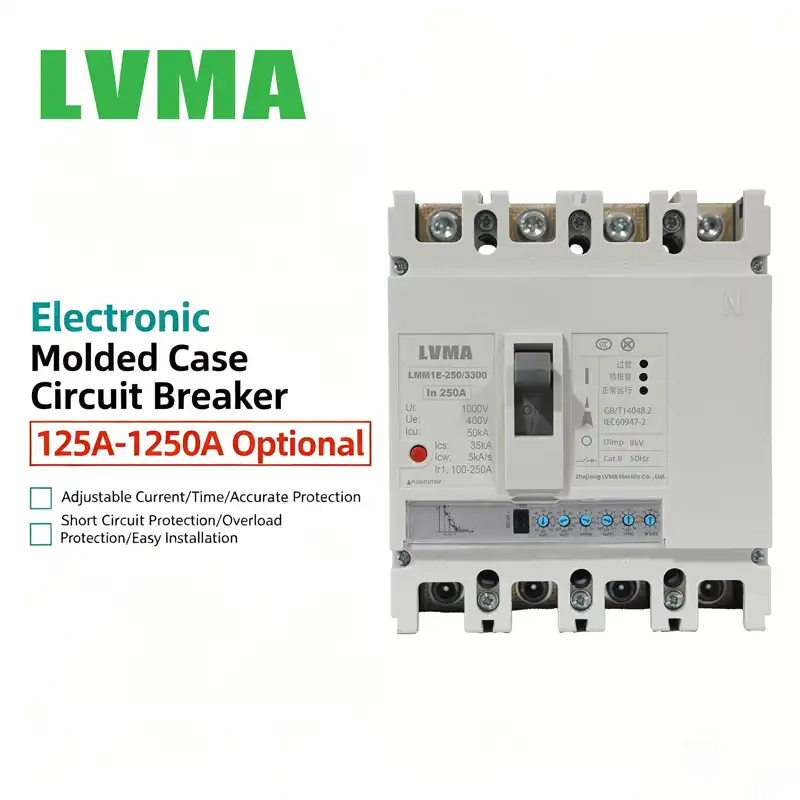
An electronic molded case circuit breaker (MCCB) is a type of molded case circuit breaker centered on an electronic trip unit. It accurately monitors, judges, and controls circuit breaking through a microprocessor, achieving comprehensive and precise protection.
I. Core Operating Principle
Unlike traditional thermal-magnetic types that rely on the mechanical action of bimetallic strips and electromagnetic coils, the electronic type adopts electronic sensing + intelligent control:
- Signal Acquisition: Built-in current transformers (CT) collect current signals of the main circuit in real time.
- Intelligent Judgment: Signals are sent to a microcontroller unit (MCU) to compare with preset parameters and identify faults such as overload and short circuit.
- Tripping Execution: In the event of a fault, the MCU sends commands to drive the tripping mechanism and quickly disconnect the main contacts.
II. Main Protection Functions (“Four-Segment Protection”)
- Long-time Delay Overload Protection (L): Trips after a certain delay in case of slight overload (inverse time delay).
- Short-time Delay Short-circuit Protection (S): Trips after a short delay (0.1~0.5 seconds) under medium short-circuit current.
- Instantaneous Short-circuit Protection (I): Trips immediately in case of severe short circuit (millisecond level).
- Ground Fault Protection (G): Detects leakage/ground faults to prevent electric shock and fire hazards.
III. Key Features
- High Protection Accuracy: Current error is generally ≤±5%, with parameters set precisely.
- Full-Function Protection: Equipped with four-segment protection (L/S/I/G) and supports selective protection.
- Intelligently Adjustable: Current, time and other parameters can be flexibly set via knobs, panels or software.
- Additional Functions: Fault memory, pre-alarm, self-diagnosis, remote communication (Modbus, etc.).
- Structure: Encased in a plastic housing with a modular design, supporting manual/electric operation.
IV. Comparison with Thermal-Magnetic MCCB
| Features | Electronic MCCB | Thermal-Magnetic MCCB |
|---|---|---|
| Tripping Principle | Electronic sensing + microprocessor | Bimetallic strip + electromagnetic coil |
| Protection Functions | Four-segment protection (L/S/I/G) | Two-segment protection (overload + instantaneous short circuit) |
| Protection Accuracy | High (±5%) | Low (±10%~30%) |
| Parameter Adjustment | Precise, wide adjustable range | Rough, narrow adjustable range |
| Selectivity | Good (coordination with grading) | Poor |
| Price | Relatively high | Relatively low |
V. Application Scenarios
- Occasions requiring high protection accuracy and selectivity: data centers, industrial production lines, precision equipment.
- Complex power distribution systems: requiring coordination between upper and lower circuit breakers to avoid unnecessary tripping.
- Smart grids: requiring remote monitoring, communication and fault diagnosis.
Contact Us
Share This Article

What is an electronic molded-case circuit breaker?
An electronic molded case circuit breaker (MCCB) is a type of molded case circuit breaker centered on an electronic trip unit. It accurately monitors, judges, and controls circuit breaking through a microprocessor, achieving comprehensive and precise protection.
I. Core Operating Principle
Unlike traditional thermal-magnetic types that rely on the mechanical action of bimetallic strips and electromagnetic coils, the electronic type adopts electronic sensing + intelligent control:
- Signal Acquisition: Built-in current transformers (CT) collect current signals of the main circuit in real time.
- Intelligent Judgment: Signals are sent to a microcontroller unit (MCU) to compare with preset parameters and identify faults such as overload and short circuit.
- Tripping Execution: In the event of a fault, the MCU sends commands to drive the tripping mechanism and quickly disconnect the main contacts.
II. Main Protection Functions (“Four-Segment Protection”)
- Long-time Delay Overload Protection (L): Trips after a certain delay in case of slight overload (inverse time delay).
- Short-time Delay Short-circuit Protection (S): Trips after a short delay (0.1~0.5 seconds) under medium short-circuit current.
- Instantaneous Short-circuit Protection (I): Trips immediately in case of severe short circuit (millisecond level).
- Ground Fault Protection (G): Detects leakage/ground faults to prevent electric shock and fire hazards.
III. Key Features
- High Protection Accuracy: Current error is generally ≤±5%, with parameters set precisely.
- Full-Function Protection: Equipped with four-segment protection (L/S/I/G) and supports selective protection.
- Intelligently Adjustable: Current, time and other parameters can be flexibly set via knobs, panels or software.
- Additional Functions: Fault memory, pre-alarm, self-diagnosis, remote communication (Modbus, etc.).
- Structure: Encased in a plastic housing with a modular design, supporting manual/electric operation.
IV. Comparison with Thermal-Magnetic MCCB
| Features | Electronic MCCB | Thermal-Magnetic MCCB |
|---|---|---|
| Tripping Principle | Electronic sensing + microprocessor | Bimetallic strip + electromagnetic coil |
| Protection Functions | Four-segment protection (L/S/I/G) | Two-segment protection (overload + instantaneous short circuit) |
| Protection Accuracy | High (±5%) | Low (±10%~30%) |
| Parameter Adjustment | Precise, wide adjustable range | Rough, narrow adjustable range |
| Selectivity | Good (coordination with grading) | Poor |
| Price | Relatively high | Relatively low |
V. Application Scenarios
- Occasions requiring high protection accuracy and selectivity: data centers, industrial production lines, precision equipment.
- Complex power distribution systems: requiring coordination between upper and lower circuit breakers to avoid unnecessary tripping.
- Smart grids: requiring remote monitoring, communication and fault diagnosis.