

Blog
2026-2-12
What is a Miniature Circuit Breaker?
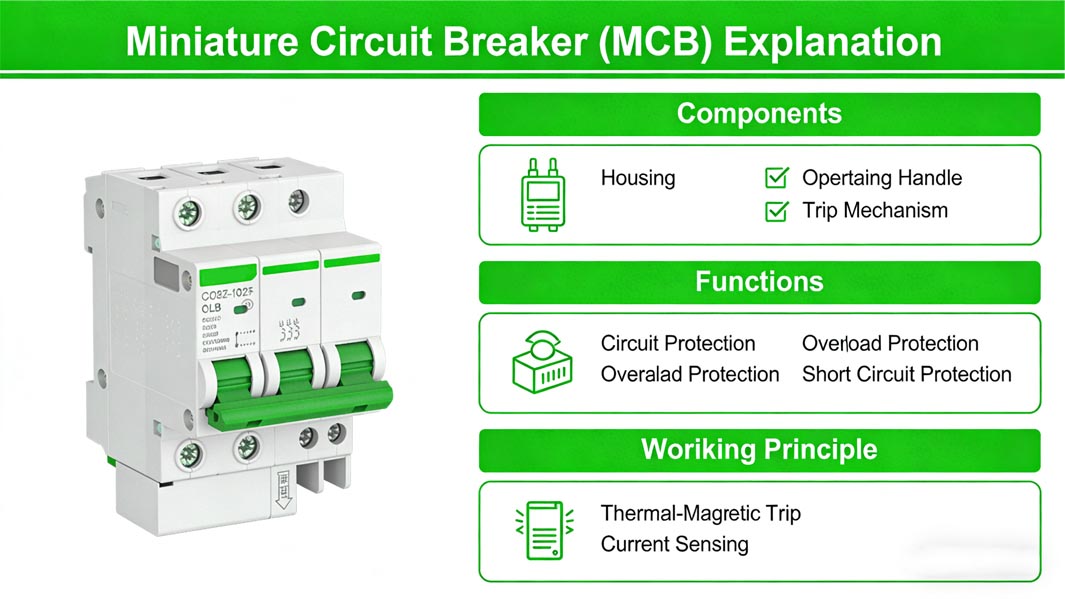
A Miniature Circuit Breaker (MCB) is a protective electrical device used in low-voltage power distribution systems. It is primarily used to protect circuits from overload and short circuits. It can automatically disconnect power in the event of an abnormal situation in the circuit, ensuring power safety.
How a Miniature Circuit Breaker works
The small circuit breaker consists mainly of parts such as the tentacle system, the arc-destroying device, the operator mechanism, and the unclasp. When the circuit is working normally, the circuit breaker is closed, and the current flows through the tentacle system to the load. When
MCB Knowledge Base
Understand the definition, classification, working principle, and key parameters of miniature circuit breakers to make informed selection decisions
Mcb Working Principle Diagram
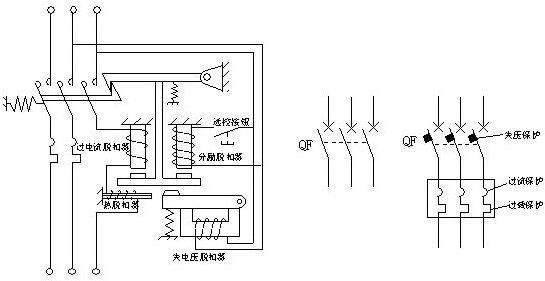
Key Parameters Explanation
| Parameter Name | Symbol | Definition | Selection Suggestion |
|---|---|---|---|
| Rated Current | In | Maximum current that the circuit breaker can carry continuously and stably | In ≥ Circuit calculated current Ic, with 1.1~1.3 times margin |
| Rated Voltage | Un | Voltage used in the circuit breaker design | Un ≥ Rated voltage of the line where it is located |
| Ultimate Breaking Capacity | Icu | Maximum short-circuit current value that the circuit breaker can break | Icu ≥ Maximum short-circuit current of the circuit where it is located |
| Service Breaking Capacity | Ics | Maximum short-circuit current value that the circuit breaker can continue to use after breaking | Important circuits require Ics=Icu to ensure reuse |
| Conventional Non-tripping Current | Int | Maximum current that the circuit breaker is not allowed to trip | Usually 1.3In or 1.45In, depending on the standard |
| Conventional Tripping Current | It | Minimum current that the circuit breaker must trip | Usually n times In, n value varies according to protection type |
Frequently Asked Questions
Product Comparison
Compare technical parameters and performance characteristics of different products to make informed choices
| Parameter | LM47-63 | LMB1-63 | LMB1-63H |
|---|---|---|---|
| Brand | LVMA | LVMA | LVMA |
| Number of Poles | 1P,2P,3P,4P | 1P,2P,3P,4P | 1P,2P,3P,4P |
| Rated Current | 63A | 63A | 63A |
| Protection Type | Type B,C,D | Type B,C,D | Type B,C,D |
| Rated Voltage | 230/400V | 230/400V | 230/400V |
| Breaking Capacity | 4kA | 6kA | 10kA |
| Width | 18mm | 18mm | 18mm |
| Leakage Protection | No | No | No |
Share This Article
What is a Miniature Circuit Breaker?
A Miniature Circuit Breaker (MCB) is a protective electrical device used in low-voltage power distribution systems. It is primarily used to protect circuits from overload and short circuits. It can automatically disconnect power in the event of an abnormal situation in the circuit, ensuring power safety.
How a Miniature Circuit Breaker works
The small circuit breaker consists mainly of parts such as the tentacle system, the arc-destroying device, the operator mechanism, and the unclasp. When the circuit is working normally, the circuit breaker is closed, and the current flows through the tentacle system to the load. When
MCB Knowledge Base
Understand the definition, classification, working principle, and key parameters of miniature circuit breakers to make informed selection decisions
Mcb Working Principle Diagram
Key Parameters Explanation
| Parameter Name | Symbol | Definition | Selection Suggestion |
|---|---|---|---|
| Rated Current | In | Maximum current that the circuit breaker can carry continuously and stably | In ≥ Circuit calculated current Ic, with 1.1~1.3 times margin |
| Rated Voltage | Un | Voltage used in the circuit breaker design | Un ≥ Rated voltage of the line where it is located |
| Ultimate Breaking Capacity | Icu | Maximum short-circuit current value that the circuit breaker can break | Icu ≥ Maximum short-circuit current of the circuit where it is located |
| Service Breaking Capacity | Ics | Maximum short-circuit current value that the circuit breaker can continue to use after breaking | Important circuits require Ics=Icu to ensure reuse |
| Conventional Non-tripping Current | Int | Maximum current that the circuit breaker is not allowed to trip | Usually 1.3In or 1.45In, depending on the standard |
| Conventional Tripping Current | It | Minimum current that the circuit breaker must trip | Usually n times In, n value varies according to protection type |
Frequently Asked Questions
Product Comparison
Compare technical parameters and performance characteristics of different products to make informed choices
| Parameter | LM47-63 | LMB1-63 | LMB1-63H |
|---|---|---|---|
| Brand | LVMA | LVMA | LVMA |
| Number of Poles | 1P,2P,3P,4P | 1P,2P,3P,4P | 1P,2P,3P,4P |
| Rated Current | 63A | 63A | 63A |
| Protection Type | Type B,C,D | Type B,C,D | Type B,C,D |
| Rated Voltage | 230/400V | 230/400V | 230/400V |
| Breaking Capacity | 4kA | 6kA | 10kA |
| Width | 18mm | 18mm | 18mm |
| Leakage Protection | No | No | No |