

The Ultimate AC Contactor Selection Guide
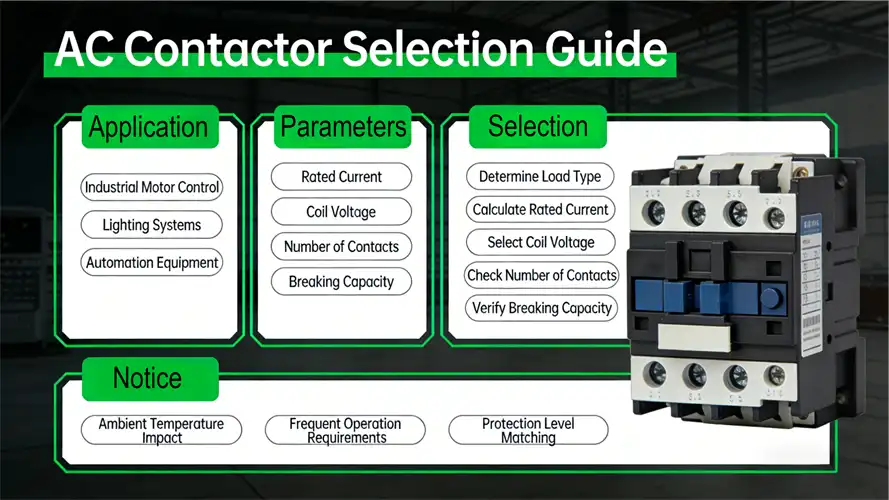
In industrial automation and electrical control systems, the AC contactor plays a critical role as the workhorse that frequently switches motors, lighting, and power circuits on and off. Yet many engineers and procurement professionals underestimate the complexity of proper contactor selection. A mismatch in specifications can lead to contact welding, coil burnout, unexpected downtime, or even safety hazards.
This comprehensive guide walks you through the entire selection process—from understanding utilization categories to matching coil voltages and avoiding common pitfalls. Whether you’re designing a new control panel or sourcing components for global projects, this guide provides the technical foundation you need for reliable, cost-effective selections.
1. Start with the Application: Why Load Type Matters Most
Before diving into current ratings or manufacturer comparisons, you must first understand your load. Different loads place vastly different demands on a contactor’s contacts. This is where utilization categories come into play—they define the specific duty the contactor must handle .
Common Utilization Categories Explained
| Category | Typical Applications | Load Characteristics |
|---|---|---|
| AC-1 | Non-inductive or slightly inductive loads, resistive furnaces, heating loads | Making and breaking current ≈ rated current |
| AC-2 | Slip-ring motors: starting, switching off | Starting current moderate, switching off at starting current |
| AC-3 | Squirrel cage motors: starting, switching off during running | Starting current 5–7× rated current; switching off at rated current |
| AC-4 | Squirrel cage motors: plugging, inching, frequent reversing | Making and breaking both at starting current (severe duty) |
| AC-5a | Discharge lamp switching | High inrush current, long starting time |
| AC-5b | Incandescent lamp switching | Inrush up to 15× rated current |
| AC-6a | Transformer switching | Inrush up to 15–20× rated current |
| AC-6b | Capacitor bank switching | Extremely high peak inrush current with high-frequency oscillation |
Key Insight: For standard motor applications (pumps, fans, compressors), AC-3 is the appropriate category. However, if your application involves frequent reversing, jogging, or plugging (e.g., cranes, hoists, elevators), you must select a contactor rated for AC-4 duty. Using an AC-3 rated contactor in AC-4 applications will dramatically reduce contact life and may cause premature failure .
Expert Tip: “Selecting a standard contactor always starts with your application consideration. Ask yourself: what type of contactor do you need—NEMA, IEC, or DP? What’s the control voltage? Is it three-phase or single-phase?” — Eaton’s contactor experts
2. Main Circuit Parameters: Voltage, Current, and Poles
2.1 Rated Voltage
The contactor’s rated insulation voltage (Ui) and rated impulse withstand voltage (Uimp) must equal or exceed the system voltage. For most industrial applications, common voltages include 230V, 400V, 690V, and up to 1000V for specialized systems .
2.2 Rated Current — The Critical Number
The fundamental rule: The contactor’s rated operational current (Ie) must be greater than the load’s full-load current for the specific utilization category.
For three-phase AC-3 motor loads, a quick estimation method: Motor current (A) ≈ Motor power (kW) × 2. For example, a 22kW motor draws approximately 44A at 400V.
However, always verify against the motor nameplate. Also note that contactors have different current ratings for different utilization categories—a contactor rated for 50A in AC-3 may have a higher AC-1 rating (heating load) but a lower AC-4 rating .
Oversizing Considerations:
-
For continuous duty (AC-3), select contactor current 30–40% above load current
-
For intermittent duty, 10–20% margin may suffice
-
For frequent short-time duty, consider additional capacity to handle thermal stress
2.3 Number of Poles
-
3-pole contactors: Standard for three-phase motor control
-
4-pole contactors: Used for controlling two independent three-phase circuits, or when switching the neutral conductor is required
-
Additional auxiliary contacts may be added for control logic and signaling
3. Control Circuit: Coil Voltage and Auxiliary Contacts
3.1 Coil Voltage Selection
The coil voltage must match your control circuit supply. Common coil voltages include:
-
24V AC/DC — Increasingly common for safety and PLC compatibility
-
110V–120V AC — Standard in North American control circuits
-
220V–240V AC — Common in European and Asian industrial systems
-
380V–480V AC — Used where control voltage matches main voltage
Selection Principle: Generally, lower coil voltages are safer and reduce insulation requirements. However, practical considerations often lead to selecting the available control voltage .
Warning: Applying incorrect coil voltage will either prevent the contactor from pulling in (undervoltage) or burn out the coil (overvoltage). Always verify .
3.2 Coil Types
-
AC coils: Simpler construction, but may produce audible hum
-
DC coils: Quieter operation, more stable holding characteristics, and often preferred in modern designs. Some manufacturers offer “electronic coils” with wide voltage ranges and low holding power consumption
3.3 Auxiliary Contacts
Auxiliary contacts (normally open NO and normally closed NC) are used for:
-
Self-holding circuits
-
Interlocking between contactors
-
Status indication to PLCs
-
Signaling lamps
Specify the required number and configuration (e.g., 1NO+1NC, 2NO+2NC). Ensure their ratings match the control circuit requirements .
4. NEMA vs. IEC vs. Definite Purpose: Which Standard to Choose?
Global buyers often face the choice between different design philosophies. Understanding the differences helps match the contactor to your application and market .
| Feature | NEMA | IEC | Definite Purpose (DP) |
|---|---|---|---|
| Market | North America | Global (IEC standard) | North America (HVAC focus) |
| Design Philosophy | Over-engineered, one-size-fits-many | Application-specific, compact | Price-driven, application-specific |
| Physical Size | Larger, more robust | Compact, modular | Compact |
| Life Expectancy | Very high | Good (application-matched) | Adequate for HVAC duty |
| Price Point | Highest | Moderate | Lowest |
| Typical Applications | Heavy industry, mining, critical processes | General industrial, OEM machinery | HVAC, refrigeration, compressors |
Selection Guidance :
-
Choose NEMA for extreme environments, heavy-duty applications, or when you want maximum durability without detailed application analysis
-
Choose IEC for global projects, space-constrained panels, or when you can precisely match the contactor to the application for cost optimization
-
Choose Definite Purpose for HVAC equipment, refrigeration units, and price-sensitive commercial applications
5. Special Load Considerations
5.1 Capacitor Bank Switching
Switching capacitor banks produces extremely high inrush currents (up to 100–200× rated current) with high-frequency oscillations . Standard contactors are not suitable for capacitor duty.
Solutions:
-
Use dedicated capacitor switching contactors with pre-charge resistors (e.g., ABB B25C, CHINT CJ19 series)
-
These contactors close auxiliary contacts first to limit inrush through resistors, then close main contacts
-
Select contactor rated for at least 1.5× capacitor rated current
5.2 Transformer Loads
Transformers draw high inrush currents (15–20× rated) when energized . For welding machines and transformer loads:
-
Select contactor rated for 2× transformer primary current
-
Consider use category AC-6a
5.3 Lighting Loads
-
Tungsten lamps: Inrush up to 15× rated; select contactor with significant margin
-
Discharge lamps: Long starting time with high inrush; select 1.1–1.4× lamp current
-
Fluorescent lamps with power factor correction: Consider capacitor switching characteristics
5.4 High-Operation-Frequency Applications
For applications exceeding 100 operations per hour (cranes, hoists, printing presses):
-
Derate the contactor or select a larger frame size
-
Consider AC-4 rated devices
-
Verify electrical life expectancy against required operations
6. Environmental Factors and Mounting
6.1 Ambient Conditions
-
Temperature: High ambient temperatures reduce current-carrying capacity. Derate above 40–55°C as specified by manufacturer
-
Humidity: Excessive moisture accelerates contact oxidation; consider sealed or coated versions
-
Altitude: Above 2,000m, air density decreases, reducing cooling and dielectric strength; derate accordingly
-
Atmosphere: Dust, corrosive gases, or conductive contaminants require IP-rated enclosures or contactors with appropriate protection
6.2 Mounting Considerations
-
Verify mounting type: DIN rail, panel mount, or screw mounting
-
Check dimensions for panel space constraints
-
Maintain minimum clearances for heat dissipation and arc quenching
7. Accessories and Coordination
7.1 Thermal Overload Relays
For motor protection, contactors are typically combined with thermal overload relays. Ensure:
-
The overload relay matches the contactor frame size
-
Current setting range covers motor full-load current
-
Ambient temperature compensation is included
7.2 Mechanical Interlocks
For reversing starters or automatic transfer switches, mechanical interlocks prevent both contactors from closing simultaneously .
7.3 Surge Suppressors
When switching inductive loads (including the contactor coil itself), arc suppressors protect control electronics:
-
RC snubbers: For AC coils
-
Diode suppressors: For DC coils (note: slows dropout)
-
Varistors (MOVs): For both AC and DC, limiting peak voltage
8. Verification Checklist
Before finalizing your selection, run through this checklist:
-
Utilization category confirmed (AC-1/AC-3/AC-4/special)
-
Rated voltage ≥ system voltage
-
Rated current ≥ load current (in correct category)
-
Number of poles correct (3/4 + auxiliaries)
-
Coil voltage matches control supply
-
Coil type (AC/DC) compatible
-
Auxiliary contacts sufficient (NO/NC count)
-
Operation frequency within contactor capability
-
Special loads (capacitor/transformer) addressed
-
Environmental conditions acceptable (temp, humidity, altitude)
-
Mounting compatible with panel
-
Accessories (overload relay, interlock, suppressor) specified
-
Certifications meet destination market requirements (CE, UL, CCC, etc.)
9. Common Selection Mistakes to Avoid
9.1 Ignoring Utilization Category
Using an AC-3 contactor for AC-4 duty will dramatically shorten contact life. For severe applications, always verify AC-4 ratings.
9.2 Undersizing for Motor Starting
While motors run at rated current, starting current (5–8×) stresses contacts. Ensure the contactor is rated for this making capacity .
9.3 Wrong Coil Voltage
One of the most common field errors. Always verify coil voltage against control circuit .
9.4 Overlooking Environmental Factors
High ambient temperature, humidity, or altitude all require derating. Check manufacturer data sheets .
9.5 Price-Only Decisions
As one expert notes: “Investing in a reliable, high-quality contactor from a trusted manufacturer pays off—it’s all about durability and peace of mind. Taking the time to do your homework and compare brands makes a real difference in the long run” .
10. Brand Comparison Snapshot
For global buyers, understanding leading brands helps contextualize options :
| Brand | Key AC Contactor Series | Distinguishing Features |
|---|---|---|
| ABB | AF Series | Wide voltage coils, silver alloy contacts, 1M operations life, DC/AC wide control range |
| Schneider Electric | TeSys D | EverLink terminals, Green design (RoHS), 1.5M operations, modular accessories |
| Siemens | 3RT Series | Electronic coils with energy-saving mode, integrated aux contacts, PROFINET communication options |
| Eaton | XT IEC / Freedom NEMA | Comprehensive NEMA and IEC portfolios, definite purpose options |
| CHINT | NC1 Series | Cost-effective, up to 690V/95A, global certifications |
| Delixi | Various | Robust construction, advanced arc quenching, competitive for emerging markets |
Conclusion: A Systematic Approach Pays Dividends
Selecting the right AC contactor is not about finding a “universal” device—it’s about matching the contactor’s capabilities to your specific application requirements. By following a systematic approach:
-
Define the load (utilization category)
-
Calculate electrical parameters (voltage, current, poles)
-
Specify control requirements (coil voltage, aux contacts)
-
Consider special conditions (capacitors, transformers, environment)
-
Verify against standards and certifications
-
Select appropriate accessories
You ensure reliable operation, extended equipment life, and minimized downtime. Whether you’re sourcing for a single machine or a global project, this structured methodology delivers consistent, cost-effective results.
For further assistance, consult manufacturer selection software or technical support teams—they can provide detailed performance curves, coordination studies, and application-specific recommendations.
Share This Article
Follow Us










The Ultimate AC Contactor Selection Guide
In industrial automation and electrical control systems, the AC contactor plays a critical role as the workhorse that frequently switches motors, lighting, and power circuits on and off. Yet many engineers and procurement professionals underestimate the complexity of proper contactor selection. A mismatch in specifications can lead to contact welding, coil burnout, unexpected downtime, or even safety hazards.
This comprehensive guide walks you through the entire selection process—from understanding utilization categories to matching coil voltages and avoiding common pitfalls. Whether you’re designing a new control panel or sourcing components for global projects, this guide provides the technical foundation you need for reliable, cost-effective selections.
1. Start with the Application: Why Load Type Matters Most
Before diving into current ratings or manufacturer comparisons, you must first understand your load. Different loads place vastly different demands on a contactor’s contacts. This is where utilization categories come into play—they define the specific duty the contactor must handle .
Common Utilization Categories Explained
| Category | Typical Applications | Load Characteristics |
|---|---|---|
| AC-1 | Non-inductive or slightly inductive loads, resistive furnaces, heating loads | Making and breaking current ≈ rated current |
| AC-2 | Slip-ring motors: starting, switching off | Starting current moderate, switching off at starting current |
| AC-3 | Squirrel cage motors: starting, switching off during running | Starting current 5–7× rated current; switching off at rated current |
| AC-4 | Squirrel cage motors: plugging, inching, frequent reversing | Making and breaking both at starting current (severe duty) |
| AC-5a | Discharge lamp switching | High inrush current, long starting time |
| AC-5b | Incandescent lamp switching | Inrush up to 15× rated current |
| AC-6a | Transformer switching | Inrush up to 15–20× rated current |
| AC-6b | Capacitor bank switching | Extremely high peak inrush current with high-frequency oscillation |
Key Insight: For standard motor applications (pumps, fans, compressors), AC-3 is the appropriate category. However, if your application involves frequent reversing, jogging, or plugging (e.g., cranes, hoists, elevators), you must select a contactor rated for AC-4 duty. Using an AC-3 rated contactor in AC-4 applications will dramatically reduce contact life and may cause premature failure .
Expert Tip: “Selecting a standard contactor always starts with your application consideration. Ask yourself: what type of contactor do you need—NEMA, IEC, or DP? What’s the control voltage? Is it three-phase or single-phase?” — Eaton’s contactor experts
2. Main Circuit Parameters: Voltage, Current, and Poles
2.1 Rated Voltage
The contactor’s rated insulation voltage (Ui) and rated impulse withstand voltage (Uimp) must equal or exceed the system voltage. For most industrial applications, common voltages include 230V, 400V, 690V, and up to 1000V for specialized systems .
2.2 Rated Current — The Critical Number
The fundamental rule: The contactor’s rated operational current (Ie) must be greater than the load’s full-load current for the specific utilization category.
For three-phase AC-3 motor loads, a quick estimation method: Motor current (A) ≈ Motor power (kW) × 2. For example, a 22kW motor draws approximately 44A at 400V.
However, always verify against the motor nameplate. Also note that contactors have different current ratings for different utilization categories—a contactor rated for 50A in AC-3 may have a higher AC-1 rating (heating load) but a lower AC-4 rating .
Oversizing Considerations:
-
For continuous duty (AC-3), select contactor current 30–40% above load current
-
For intermittent duty, 10–20% margin may suffice
-
For frequent short-time duty, consider additional capacity to handle thermal stress
2.3 Number of Poles
-
3-pole contactors: Standard for three-phase motor control
-
4-pole contactors: Used for controlling two independent three-phase circuits, or when switching the neutral conductor is required
-
Additional auxiliary contacts may be added for control logic and signaling
3. Control Circuit: Coil Voltage and Auxiliary Contacts
3.1 Coil Voltage Selection
The coil voltage must match your control circuit supply. Common coil voltages include:
-
24V AC/DC — Increasingly common for safety and PLC compatibility
-
110V–120V AC — Standard in North American control circuits
-
220V–240V AC — Common in European and Asian industrial systems
-
380V–480V AC — Used where control voltage matches main voltage
Selection Principle: Generally, lower coil voltages are safer and reduce insulation requirements. However, practical considerations often lead to selecting the available control voltage .
Warning: Applying incorrect coil voltage will either prevent the contactor from pulling in (undervoltage) or burn out the coil (overvoltage). Always verify .
3.2 Coil Types
-
AC coils: Simpler construction, but may produce audible hum
-
DC coils: Quieter operation, more stable holding characteristics, and often preferred in modern designs. Some manufacturers offer “electronic coils” with wide voltage ranges and low holding power consumption
3.3 Auxiliary Contacts
Auxiliary contacts (normally open NO and normally closed NC) are used for:
-
Self-holding circuits
-
Interlocking between contactors
-
Status indication to PLCs
-
Signaling lamps
Specify the required number and configuration (e.g., 1NO+1NC, 2NO+2NC). Ensure their ratings match the control circuit requirements .
4. NEMA vs. IEC vs. Definite Purpose: Which Standard to Choose?
Global buyers often face the choice between different design philosophies. Understanding the differences helps match the contactor to your application and market .
| Feature | NEMA | IEC | Definite Purpose (DP) |
|---|---|---|---|
| Market | North America | Global (IEC standard) | North America (HVAC focus) |
| Design Philosophy | Over-engineered, one-size-fits-many | Application-specific, compact | Price-driven, application-specific |
| Physical Size | Larger, more robust | Compact, modular | Compact |
| Life Expectancy | Very high | Good (application-matched) | Adequate for HVAC duty |
| Price Point | Highest | Moderate | Lowest |
| Typical Applications | Heavy industry, mining, critical processes | General industrial, OEM machinery | HVAC, refrigeration, compressors |
Selection Guidance :
-
Choose NEMA for extreme environments, heavy-duty applications, or when you want maximum durability without detailed application analysis
-
Choose IEC for global projects, space-constrained panels, or when you can precisely match the contactor to the application for cost optimization
-
Choose Definite Purpose for HVAC equipment, refrigeration units, and price-sensitive commercial applications
5. Special Load Considerations
5.1 Capacitor Bank Switching
Switching capacitor banks produces extremely high inrush currents (up to 100–200× rated current) with high-frequency oscillations . Standard contactors are not suitable for capacitor duty.
Solutions:
-
Use dedicated capacitor switching contactors with pre-charge resistors (e.g., ABB B25C, CHINT CJ19 series)
-
These contactors close auxiliary contacts first to limit inrush through resistors, then close main contacts
-
Select contactor rated for at least 1.5× capacitor rated current
5.2 Transformer Loads
Transformers draw high inrush currents (15–20× rated) when energized . For welding machines and transformer loads:
-
Select contactor rated for 2× transformer primary current
-
Consider use category AC-6a
5.3 Lighting Loads
-
Tungsten lamps: Inrush up to 15× rated; select contactor with significant margin
-
Discharge lamps: Long starting time with high inrush; select 1.1–1.4× lamp current
-
Fluorescent lamps with power factor correction: Consider capacitor switching characteristics
5.4 High-Operation-Frequency Applications
For applications exceeding 100 operations per hour (cranes, hoists, printing presses):
-
Derate the contactor or select a larger frame size
-
Consider AC-4 rated devices
-
Verify electrical life expectancy against required operations
6. Environmental Factors and Mounting
6.1 Ambient Conditions
-
Temperature: High ambient temperatures reduce current-carrying capacity. Derate above 40–55°C as specified by manufacturer
-
Humidity: Excessive moisture accelerates contact oxidation; consider sealed or coated versions
-
Altitude: Above 2,000m, air density decreases, reducing cooling and dielectric strength; derate accordingly
-
Atmosphere: Dust, corrosive gases, or conductive contaminants require IP-rated enclosures or contactors with appropriate protection
6.2 Mounting Considerations
-
Verify mounting type: DIN rail, panel mount, or screw mounting
-
Check dimensions for panel space constraints
-
Maintain minimum clearances for heat dissipation and arc quenching
7. Accessories and Coordination
7.1 Thermal Overload Relays
For motor protection, contactors are typically combined with thermal overload relays. Ensure:
-
The overload relay matches the contactor frame size
-
Current setting range covers motor full-load current
-
Ambient temperature compensation is included
7.2 Mechanical Interlocks
For reversing starters or automatic transfer switches, mechanical interlocks prevent both contactors from closing simultaneously .
7.3 Surge Suppressors
When switching inductive loads (including the contactor coil itself), arc suppressors protect control electronics:
-
RC snubbers: For AC coils
-
Diode suppressors: For DC coils (note: slows dropout)
-
Varistors (MOVs): For both AC and DC, limiting peak voltage
8. Verification Checklist
Before finalizing your selection, run through this checklist:
-
Utilization category confirmed (AC-1/AC-3/AC-4/special)
-
Rated voltage ≥ system voltage
-
Rated current ≥ load current (in correct category)
-
Number of poles correct (3/4 + auxiliaries)
-
Coil voltage matches control supply
-
Coil type (AC/DC) compatible
-
Auxiliary contacts sufficient (NO/NC count)
-
Operation frequency within contactor capability
-
Special loads (capacitor/transformer) addressed
-
Environmental conditions acceptable (temp, humidity, altitude)
-
Mounting compatible with panel
-
Accessories (overload relay, interlock, suppressor) specified
-
Certifications meet destination market requirements (CE, UL, CCC, etc.)
9. Common Selection Mistakes to Avoid
9.1 Ignoring Utilization Category
Using an AC-3 contactor for AC-4 duty will dramatically shorten contact life. For severe applications, always verify AC-4 ratings.
9.2 Undersizing for Motor Starting
While motors run at rated current, starting current (5–8×) stresses contacts. Ensure the contactor is rated for this making capacity .
9.3 Wrong Coil Voltage
One of the most common field errors. Always verify coil voltage against control circuit .
9.4 Overlooking Environmental Factors
High ambient temperature, humidity, or altitude all require derating. Check manufacturer data sheets .
9.5 Price-Only Decisions
As one expert notes: “Investing in a reliable, high-quality contactor from a trusted manufacturer pays off—it’s all about durability and peace of mind. Taking the time to do your homework and compare brands makes a real difference in the long run” .
10. Brand Comparison Snapshot
For global buyers, understanding leading brands helps contextualize options :
| Brand | Key AC Contactor Series | Distinguishing Features |
|---|---|---|
| ABB | AF Series | Wide voltage coils, silver alloy contacts, 1M operations life, DC/AC wide control range |
| Schneider Electric | TeSys D | EverLink terminals, Green design (RoHS), 1.5M operations, modular accessories |
| Siemens | 3RT Series | Electronic coils with energy-saving mode, integrated aux contacts, PROFINET communication options |
| Eaton | XT IEC / Freedom NEMA | Comprehensive NEMA and IEC portfolios, definite purpose options |
| CHINT | NC1 Series | Cost-effective, up to 690V/95A, global certifications |
| Delixi | Various | Robust construction, advanced arc quenching, competitive for emerging markets |
Conclusion: A Systematic Approach Pays Dividends
Selecting the right AC contactor is not about finding a “universal” device—it’s about matching the contactor’s capabilities to your specific application requirements. By following a systematic approach:
-
Define the load (utilization category)
-
Calculate electrical parameters (voltage, current, poles)
-
Specify control requirements (coil voltage, aux contacts)
-
Consider special conditions (capacitors, transformers, environment)
-
Verify against standards and certifications
-
Select appropriate accessories
You ensure reliable operation, extended equipment life, and minimized downtime. Whether you’re sourcing for a single machine or a global project, this structured methodology delivers consistent, cost-effective results.
For further assistance, consult manufacturer selection software or technical support teams—they can provide detailed performance curves, coordination studies, and application-specific recommendations.
Contact Us
Share This Article
Contact Us
Have questions about our products or services? Our team is here to help you with any inquiries.